Two weeks ago I gave talk titled “Two Combings of \(\mathbb{Z}^2\)”. The talk was about some material I have been discussing lately with my honours supervisor. The talk went well and I thought it would be worth sharing a written version of what I said.
Geometric Group Theory
Combings are a tool that gets used in a branch of mathematics called geometric group theory. Geometric group theory is a relatively new area of mathematics and is only around 30 years old. The main idea behind geometric group theory is to use tools and ideas from geometry and low dimensional topology to study and understand groups. It turns out that some of the simplest questions one can ask about groups have interesting geometric answers. For instance, the Dehn function of a group gives a natural geometric answer to the solvability of the word problem.
Generators
Before we can define what a combing is we’ll need to set up some notation. If \(A\) is a set then we will write \(A^*\) for the set of words written using elements of \(A\) and inverses of elements of \(A\). For instance if \(A = \{a,b\}\), then \(A^* = \{\varepsilon, a,b,a^{-1},b^{-1},aa=a^2,abb^{-1}a^{-3},\ldots\}\) (here \(\varepsilon\) refers to the empty word). If \(w\) is a word in \(A^*\), we will write \(l(w)\) for the length of \(w\). Thus \(l(\varepsilon)=0, l(a)=1, l(abb^{-1}a^{-3})=6\) and so on.
If \(G\) is a group and \(A\) is a subset of \(G\), then we have a natural map \(\pi : A^* \rightarrow G\) given by:
\(\pi(a_1^{\pm 1}a_2^{\pm 1}\ldots a_n^{\pm 1}) = a_1^{\pm 1}\cdot a_2^{\pm 1} \cdot \ldots \cdot a_n^{\pm 1}\).
We will say that \(A\) generates \(G\) if the above map is surjective. In this case we will write \(\overline{w}\) for \(\pi(w)\) when \(w\) is a word in \(A^*\).
The Word Metric
The geometry in “geometric group theory” often arises when studying how a group acts on different geometric spaces. A group always acts on itself by left multiplication. The following definition adds a geometric aspect to this action. If \(G\) is a group with generators \(A\), then the word metric on \(G\) with respect to \(A\) is the function \(d_G : G \times G \rightarrow \mathbb{R}\) given by
\(d_G(g,h) = \min \{ l(w) \mid w \in A^*, \overline{w} = g^{-1}h \}.\)
That, is the distance between two group elements \(g,h \in G\) is the length of the shortest word in \(A^*\) we can use to represent \(g^{-1}h\). Equivalently the distance between \(g\) and \(h\) is the length of the shortest word we have to append to \(g\) to produce \(h\). This metric is invariant under left-multiplication by \(G\) (ie \(d_G(g\cdot h,g\cdot h’) =d_G(h,h’)\) for all \(g,h,h’ \in G\)). Thus \(G\) acts on \((G,d_G)\) by isometries.
Words are Paths
Now that we are viewing the group \(G\) as a geometric space, we can also change how we think of words \(w \in A^*\). Such a word can be thought of as discrete path in \(G\). That is we can think of \(w\) as a function from \(\mathbb{N}\) to \(G\). This way of thinking of \(w\) as a discrete path is best illuminated with an example. Suppose we have the word \(w = ab^2a^{-1}b\), then
\(w(0) = e,\)
\(w(1) = \overline{a}\)
\(w(2) = \overline{ab}\)
\(w(3) = \overline{ab^2}\)
\(w(4) = \overline{ab^2a^{-1}}\)
\(w(5) = \overline{ab^2a^{-1}b}\)
\(w(t) = \overline{ab^2a^{-1}b},\) \(t \ge 5\).
Thus the path \(w : \mathbb{N} \rightarrow G\) is given by taking the first \(t\) letters of \(w\) and mapping this word to the group element it represents. With this interpretation of word in \(A^*\) in mind we can now define combings.
Combings
Let \(G\) be a group with a finite set of generators \(A\). Then a combing of \(G\) with respect to \(A\) is a function \(\sigma : G \rightarrow A^*\) such that
- For all \(g \in G\), \(\overline{\sigma_g} = g\) (we will write \(\sigma_g\) for \(\sigma(g))\).
- There exists \(k >0\) such that for all \( g, h \in G\) with \(g \cdot \overline{a} = h\) for some \(a \in A\), we have that \(d_G(\sigma_g(t),\sigma_h(t)) \le k\) for all \(t \in \mathbb{N}\).
The first condition says that we can think of \(\sigma\) as a way of picking a normal form \(\sigma_g \in A^*\) for each \(g \in G\). The second condition is a bit more involved. It states that if the group elements \(g, h \in G\) are distance 1 from each other in the word metric, then the paths \(\sigma_g,\sigma_h : \mathbb{N} \rightarrow G\) are within distance \(k\) of each other at any point in time.
An Example
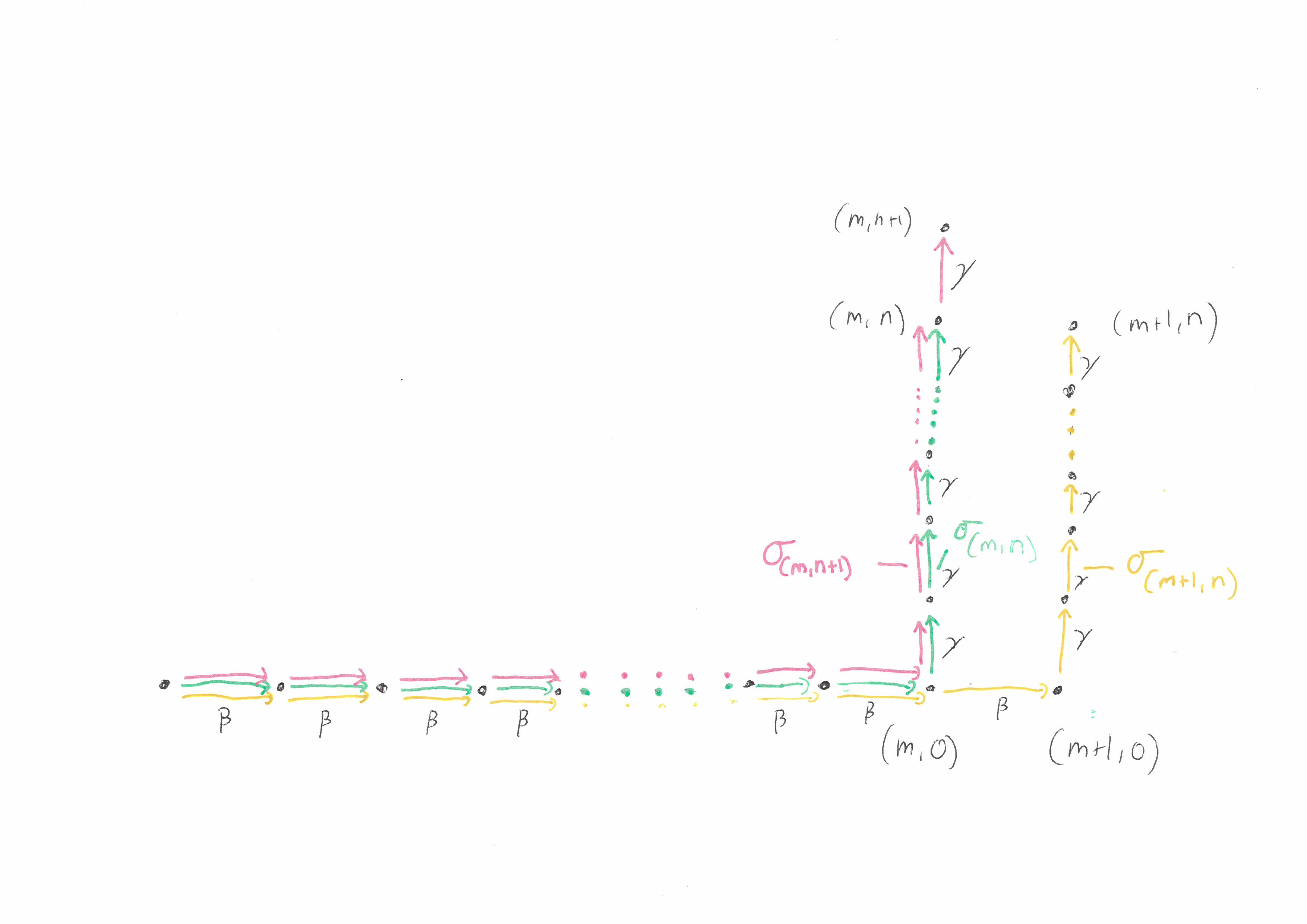
Not all groups can be given a combing. Indeed if we have a combing of \(G\), then the word problem in \(G\) is solvable and the Dehn function of \(G\) is at most exponential. One group that does admit a combing is \(\mathbb{Z}^2 = \{(m,n) \mid m,n \in \mathbb{Z}\}\). This group is generated by \(A = \{(1,0),(0,1)\} = \{\beta,\gamma\}\) and one combing of \(\mathbb{Z}^2\) with respect to this generating set is
\(\sigma_{(m,n)} = \beta^m\gamma^n\).
The first condition of being a combing is clearly satisfied and the following picture shows that the second condition can be satisfied with \(k = 2\).
A Non-Example
The discrete Heisenberg group, \(H_3\), can be given by the following presentation
\(H_3 = \langle \alpha,\beta,\gamma \mid \alpha\gamma = \gamma\alpha, \beta\gamma = \gamma\beta, \beta\alpha = \alpha\beta\gamma \rangle\).
That is, the group \(H_3\) has three generators \(\alpha,\beta\) and \(\gamma\). The generator \(\gamma\) commutes with both \(\alpha\) and \(\beta\). The generators \(\alpha\) and \(\beta\) almost commute but don’t quite as seen in the relation \(\beta\alpha = \alpha\beta\gamma\).
Any \(h \in H_3\) can be represented uniquely as \(\sigma_h = \alpha^p\beta^m\gamma^n\) for \(p,m,n \in \mathbb{Z}\). To see why such a representation exists it’s best to consider an example. Suppose that \(h = \overline{\gamma\beta\alpha\gamma\alpha\beta\gamma}\). Then we can use the fact that \(\gamma\) commutes with \(\alpha\) and \(\beta\) to push all \(\gamma\)’s to the right and we get that \(h = \overline{\beta\alpha\alpha\beta\gamma^3}\). We can then apply the third relation to switch the order of \(\alpha\) and \(\beta\) on the right. This gives us that that \(h = \overline{\alpha\beta\gamma\alpha\beta\gamma^3}=\overline{\alpha\beta\alpha\beta\gamma^4}\). If we apply this relation once more we get that \(h = \overline{\alpha^2\beta^2\gamma^5}\) and thus \(\sigma_h = \alpha^2\beta^2\gamma^5\). The procedure used to write \(h\) in the form \(\alpha^p\beta^m\gamma^n\) can be generalized to any word written using \(\alpha^{\pm 1}, \beta^{\pm 1}, \gamma^{\pm 1}\).
The fact the such a representation is unique (that is if \(\overline{\alpha^p\beta^m\gamma^n} = \overline{\alpha^{p’}\beta^{m’}\gamma^{n’}}\), then \((p,m,n) = (p’,m’,n’)\)) is harder to justify but can be proved by defining an action of \(H_3\) on \(\mathbb{Z}^3\). Thus we can define a function \(\sigma : H_3 \rightarrow \{\alpha,\beta,\gamma\}^*\) by setting \(\sigma_h\) to be the unique word of the form \(\alpha^p \beta^m\gamma^n\) that represents \(h\). This map satisfies the first condition of being a combing and has many nice properties. These include that it is easy to check whether or not a word in \(\{\alpha,\beta,\gamma\}^*\) is equal to \(\sigma_h\) for some \(h \in H_3\) and there are fast algorithms for putting a word in \(\{\alpha,\beta,\gamma\}^*\) into its normal form. Unfortunately this map fails to be a combing.
The reason why \(\sigma : H_3 \rightarrow \{\alpha,\beta,\gamma\}^*\) fails to be a combing can be seen back when we turned \(\overline{ \gamma\beta\alpha\gamma\alpha\beta\gamma }\) into \( \overline{\alpha^2\beta^2\gamma^5} \). To move \(\alpha\)’s on the right to the left we had to move past \(\beta\)’s and produce \(\gamma\)’s in the process. More concretely fix \(m \in \mathbb{N}\) and let \(h = \overline{\beta^m}\) and \(g = \overline{\beta^m \alpha} = \overline{\alpha \beta^m\gamma^m}\). We have \(\sigma_h = \beta^m\) and \(\sigma_g = \alpha \beta^m \gamma^m\). The group elements \(g\) and \(h\) differ by a generator. Thus, if \(\sigma\) was a combing we should be able to uniformly bound \(d_{H_3}(\sigma_g(t),\sigma_h(t))\) for all \(t \in \mathbb{N}\) and all \(m \in \mathbb{N}\).
If we then let \(t = m+1\), we can recall that
\(d_{H_3}(\sigma_g(t),\sigma_h(t)) = \min\{l(w) \mid w \in \{\alpha,\beta,\gamma\}^*, \overline{w} = \sigma_g(t)^{-1}\sigma_h(t)\}.\)
We have that \(\sigma_h(t) = \overline{\beta^m}\) and \(\sigma_g(t) = \overline{\alpha \beta^m}\) and thus
\(\sigma_g(t)^{-1}\sigma_h(t) = (\overline{\alpha\beta^m})^{-1}\overline{\beta^m} = \overline{\beta^{-m}\alpha^{-1}\beta^m} = \overline{\alpha^{-1}\beta^{-m}\gamma^{m}\beta^m}=\overline{\alpha^{-1}\gamma^{m}}.\)
The group element \(\overline{\alpha^{-1}\gamma^{m}}\) cannot be represented as a shorter element of \(\{\alpha,\beta,\gamma\}^*\) and thus \(d_{H_3}(\sigma_g(t),\sigma_h(t)) = m+1\) and the map \(\sigma \) is not a combing.
Can we comb the Heisenberg group?
This leaves us with a question, can we comb the group \(H_3\)? It turns out that we can but the answer actually lies in finding a better combing of \(\mathbb{Z}^2\). This is because \(H_3\) contains the subgroup \(\mathbb{Z}^2 \cong \langle \beta, \gamma \rangle \subseteq H_3\). Rather than using the normal form \(\sigma_h = \alpha^p \beta^m \gamma^n\), we will use \(\sigma’_h = \alpha^p \tau_{(m,n)}\) where \(\tau : \mathbb{Z}^2 \rightarrow \{\beta,\gamma \}^*\) is a combing of \(\mathbb{Z}^2\) that is more symmetric. The word \(\tau_{(m,n)}\) is defined to be the sequence of \(m \) \(\beta\)’s and \(n\) \(\gamma\)’s that stays closest to the straight line in \(\mathbb{R}^2\) that joins \((0,0)\) to \((n,p)\) (when we view \(\beta\) and \(\gamma\) as representing \((1,0)\) and \((0,1)\) respectively). Below is an illustration:
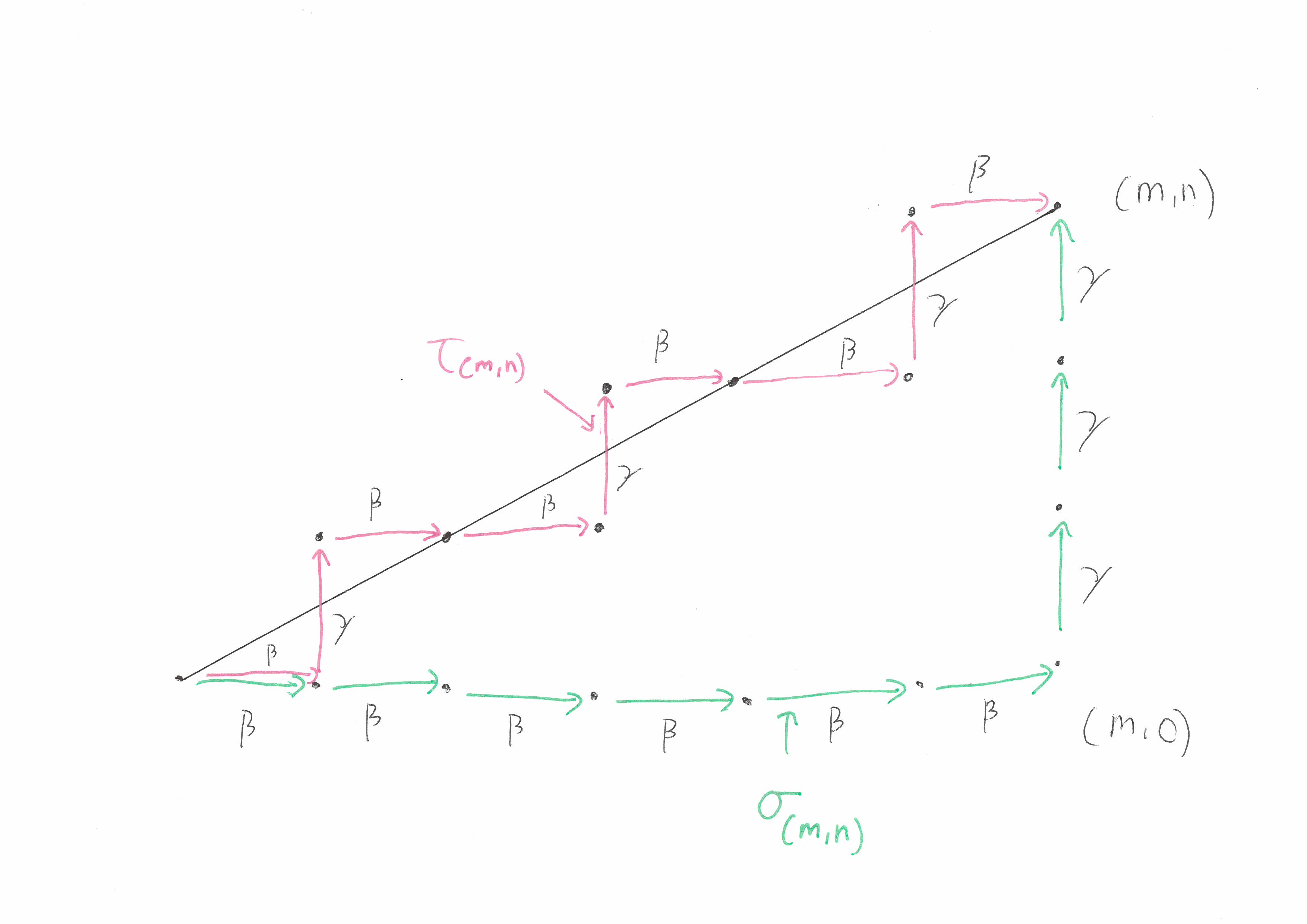
This new function isn’t quite a combing of \(H_3\) but it is the next best thing! It is an asynchronous combing. An asynchronous combing is one where we again require that the paths \(\sigma_h,\sigma_g\) stay close to each other whenever \(h\) and \(g\) are close to each other. However we allow the paths \(\sigma_h\) and \(\sigma_g\) to travel at different speeds. Many of the results that can be proved for combable groups extend to asynchronously combable groups.
References
Hairdressing in Groups by Sarah Rees is a survey paper that includes lots examples of groups that do or do not admit combings. It also talks about the language complexity of a combing, something I didn’t have time to touch on in my talk.
Combings of Semidirect Products and 3-Manifold Groups by Martin Bridson contains a proof that \(H_3\) is asynchornously combable. He actually proves the more general result that any group of the form \(\mathbb{Z}^n \rtimes \mathbb{Z}^m\) is asynchronously combable.
Thank you to my supervisor, Tony Licata, for suggesting I give my talk on combing \(H_3\) and for all the support he has given me so far.
Leave a Reply