Tag: mathematics

  • A not so simple conditional expectation

    It is winter 2022 and my PhD cohort has moved on the second quarter of our first year statistics courses. This means we’ll be learning about generalised linear models in our applied course, asymptotic statistics in our theory course and conditional expectations and martingales in our probability course.

    In the first week of our probability course we’ve been busy defining and proving the existence of the conditional expectation. Our approach has been similar to how we constructed the Lebesgue integral in the previous course. Last quarter, we first defined the Lebesgue integral for simple functions, then we used a limiting argument to define the Lebesgue integral for non-negative functions and then finally we defined the Lebesgue integral for arbitrary functions by considering their positive and negative parts.

    Our approach to the conditional expectation has been similar but the journey has been different. We again started with simple random variables, then progressed to non-negative random variables and then proved the existence of the conditional expectation of any arbitrary integrable random variable. Unlike the Lebesgue integral, the hardest step was proving the existence of the conditional expectation of a simple random variable. Progressing from simple random variables to arbitrary random variables was a straight forward application of the monotone convergence theorem and linearity of expectation. But to prove the existence of the conditional expectation of a simple random variable we needed to work with projections in the Hilbert space \(L^2(\Omega, \mathbb{P},\mathcal{F})\).

    Unlike the Lebesgue integral, defining the conditional expectation of a simple random variable is not straight forward. One reason for this is that the conditional expectation of a random variable need not be a simple random variable. This comment was made off hand by our Professor and sparked my curiosity. The following example is what I came up with. Below I first go over some definitions and then we dive into the example.

    A simple random variable with a conditional expectation that is not simple

    Let \((\Omega, \mathbb{P}, \mathcal{F})\) be a probability space and let \(\mathcal{G} \subseteq \mathcal{F}\) be a sub-\(\sigma\)-algebra. The conditional expectation of an integrable random variable \(X\) is a random variable \(\mathbb{E}(X|\mathcal{G})\) that satisfies the following two conditions:

    1. The random variable \(\mathbb{E}(X|\mathcal{G})\) is \(\mathcal{G}\)-measurable.
    2. For all \(B \in \mathcal{G}\), \(\mathbb{E}[X1_B] = \mathbb{E}[\mathbb{E}(X|\mathcal{G})1_B]\), where \(1_B\) is the indicator function of \(B\).

    The conditional expectation of an integrable random variable is unique and always exists. One can think of \(\mathbb{E}(X|\mathcal{G})\) as the expected value of \(X\) given the information in \(\mathcal{G}\).

    A simple random variable is a random variable \(X\) that take only finitely many values. Simple random variables are always integrable and so \(\mathbb{E}(X|\mathcal{G})\) always exists but we will see that \(\mathbb{E}(X|\mathcal{G})\) need not be simple.

    Consider a random vector \((U,V)\) uniformly distributed on the square \([-1,1]^2 \subseteq \mathbb{R}^2\). Let \(D\) be the unit disc \(D = \{(u,v) \in \mathbb{R}^2:u^2+v^2 \le 1\}\). The random variable \(X = 1_D(U,V)\) is a simple random variable since \(X\) equals \(1\) if \((U,V) \in D\) and \(X\) equals \(0\) otherwise. Let \(\mathcal{G} = \sigma(U)\) the \(\sigma\)-algebra generated by \(U\). It turns out that

    \(\mathbb{E}(X|\mathcal{G}) = \sqrt{1-U^2}\).

    Thus \(\mathbb{E}(X|\mathcal{G})\) is not a simple random variable. Let \(Y = \sqrt{1-U^2}\). Since \(Y\) is a continuous function of \(U\), the random variable is \(\mathcal{G}\)-measurable. Thus \(Y\) satisfies condition 1. Furthermore if \(B \in \mathcal{G}\), then \(B = \{U \in A\}\) for some measurable set \(A\subseteq [-1,1]\). Thus \(X1_B\) equals \(1\) if and only if \(U \in A\) and \(V \in [-\sqrt{1-U^2}, \sqrt{1-U^2}]\). Since \((U,V)\) is uniformly distributed we thus have

    \(\mathbb{E}[X1_B] = \int_A \int_{-\sqrt{1-u^2}}^{\sqrt{1-u^2}} \frac{1}{4}dvdu = \int_A \frac{1}{2}\sqrt{1-u^2}du\).

    The random variable \(U\) is uniformly distributed on \([-1,1]\) and thus has density \(\frac{1}{2}1_{[-1,1]}\). Therefore,

    \(\mathbb{E}[Y1_B] = \mathbb{E}[\sqrt{1-U^2}1_{\{U \in A\}}] = \int_A \frac{1}{2}\sqrt{1-u^2}du\).

    Thus \(\mathbb{E}[X1_B] = \mathbb{E}[Y1_B]\) and therefore \(Y = \sqrt{1-U^2}\) equals \(\mathbb{E}(X|\mathcal{G})\). Intuitively we can see this because given \(U=u\), we know that \(X\) is \(1\) when \(V \in [-\sqrt{1-u^2},\sqrt{1+u^2}]\) and that \(X\) is \(0\) otherwise. Since \(V\) is uniformly distributed on \([-1,1]\) the probability that \(V\) is in \([-\sqrt{1-u^2},\sqrt{1+u^2}]\) is \(\sqrt{1-u^2}\). Thus given \(U=u\), the expected value of \(X\) is \(\sqrt{1-u^2}\).

    An extension

    The previous example suggests an extension that shows just how “complicated” the conditional expectation of a simple random variable can be. I’ll state the extension as an exercise:

    Let \(f:[-1,1]\to \mathbb{R}\) be any continuous function with \(f(x) \in [0,1]\). With \((U,V)\) and \(\mathcal{G}\) as above show that there exists a measurable set \(A \subseteq [-1,1]^2\) such that \(\mathbb{E}(1_A|\mathcal{G}) = f(U)\).
  • Extremal couplings

    This post is inspired by an assignment question I had to answer for STATS 310A – a probability course at Stanford for first year students in the statistics PhD program. In the question we had to derive a few results about couplings. I found myself thinking and talking about the question long after submitting the assignment and decided to put my thoughts on paper. I would like to thank our lecturer Prof. Diaconis for answering my questions and pointing me in the right direction.

    What are couplings?

    Given two distribution functions \(F\) and \(G\) on \(\mathbb{R}\), a coupling of \(F\) and \(G\) is a distribution function \(H\) on \(\mathbb{R}^2\) such that the marginals of \(H\) are \(F\) and \(G\). Couplings can be used to give probabilistic proofs of analytic statements about \(F\) and \(G\) (see here). Couplings are also are studied in their own right in the theory optimal transport.

    We can think of \(F\) and \(G\) as being the cumulative distribution functions of some random variables \(X\) and \(Y\). A coupling \(H\) of \(F\) and \(G\) thus corresponds to a random vector \((\widetilde{X},\widetilde{Y})\) where \(\widetilde{X}\) has the same distribution as \(X\), \(\widetilde{Y}\) has the same distribution as \(Y\) and \((\widetilde{X},\widetilde{Y}) \sim H\).

    The independent coupling

    For two given distributions function \(F\) and \(G\) there exist many possible couplings. For example we could take \(H = H_I\) where \(H_I(x,y) = F(x)G(y)\). This coupling corresponds to a random vector \((\widetilde{X}_I,\widetilde{Y}_I)\) where \(\widetilde{X}_I\) and \(\widetilde{Y}_I\) are independent and (as is required for all couplings) \(\widetilde{X}_I \stackrel{\text{dist}}{=} X\), \(\widetilde{Y}_I \stackrel{\text{dist}}{=} Y\).

    In some sense the coupling \(H_I\) is in the “middle” of all couplings. This is because \(\widetilde{X}\) and \(\widetilde{Y}\) are independent and so \(\widetilde{X}\) doesn’t carry any information about \(\widetilde{Y}\). As the title of the post suggests, there are couplings were this isn’t the case and \(\widetilde{X}\) carries “as much information as possible” about \(\widetilde{Y}\).

    The two extremal couplings

    Define two function \(H_L, H_U :\mathbb{R}^2 \to [0,1]\) by

    \(H_U(x,y) = \min\{F(x), G(y)\}\) and \(H_L(x,y) = \max\{F(x)+G(y) – 1, 0\}\).

    With some work, one can show that \(H_L\) and \(H_U\) are distributions functions on \(\mathbb{R}^2\) and that they have the correct marginals. In this post I would like to talk about how to construct random vectors \((\widetilde{X}_U, \widetilde{Y}_U) \sim H_U\) and \((\widetilde{X}_L, \widetilde{Y}_L) \sim H_L\).

    Let \(F^{-1}\) and \(G^{-1}\) be the quantile functions of \(F\) and \(G\). That is,

    \(F^{-1}(c) = \inf\{ x \in \mathbb{R} : F(x) \ge c\}\) and \(G^{-1}(c) = \inf\{ x \in \mathbb{R} : G(x) \ge c\}\).

    Now let \(V\) be a random variable that is uniformly distributed on \([0,1]\) and define

    \(\widetilde{X}_U = F^{-1}(V)\) and \(\widetilde{Y}_U = G^{-1}(V)\).

    Since \(F^{-1}(V) \le x\) if and only if \(V \le F(x)\), we have \(\widetilde{X}_U \stackrel{\text{dist}}{=} X\) and likewise \(\widetilde{Y}_U \stackrel{\text{dist}}{=} Y\). Furthermore \(\widetilde{X}_U \le x, \widetilde{Y}_U \le y\) occurs if and only if \(V \le F(x), V \le G(y)\) which is equivalent to \(V \le \min\{F(x),G(y)\}\). Thus

    \(\mathbb{P}(\widetilde{X}_U \le x, \widetilde{Y}_U \le y) = \mathbb{P}(V \le \min\{F(x),G(y)\})= \min\{F(x),G(y)\}.\)

    Thus \((\widetilde{X}_U,\widetilde{Y}_U)\) is distributed according to \(H_U\). We see that under the coupling \(H_U\), \(\widetilde{X}_U\) and \(\widetilde{Y}_U\) are closely related as they are both increasing functions of a common random variable \(V\).

    We can follow a similar construction for \(H_L\). Define

    \(\widetilde{X}_L = F^{-1}(V)\) and \(\widetilde{Y}_L = G^{-1}(1-V)\).

    Thus \(\widetilde{X}_L\) and \(\widetilde{Y}_L\) are again functions of a common random variable \(V\) but \(\widetilde{X}_L\) is an increasing function of \(V\) and \(\widetilde{Y}_L\) is a decreasing function of \(V\). Note that \(1-V\) is also uniformly distributed on \([0,1]\). Thus \(\widetilde{X}_L \stackrel{\text{dist}}{=} X\) and \(\widetilde{Y}_L \stackrel{\text{dist}}{=} Y\).

    Now \(\widetilde{X}_L \le x, \widetilde{Y}_L \le y\) occurs if and only if \(V \le F(x)\) and \(1-V \le G(y)\) which occurs if and only if \(1-G(y) \le V \le F(x)\). If \(1-G(y) \le F(x)\), then \(F(x)+G(y)-1 \ge 0\) and \(\mathbb{P}(1-G(y) \le V \le F(x)) =F(x)+G(y)-1\). On the other hand, if \(1 – G(y) > F(x)\), then \(F(x)+G(y)-1< 0\) and \(\mathbb{P}(1-G(y) \le V \le F(x))=0\). Thus

    \(\mathbb{P}(\widetilde{X}_L \le x, \widetilde{Y}_L \le y) = \mathbb{P}(1-G(y) \le V \le F(x)) = \max\{F(x)+G(y)-1,0\}\),

    and so \((\widetilde{X}_L,\widetilde{Y}_L)\) is distributed according to \(H_L\).

    What makes \(H_U\) and \(H_L\) extreme?

    Now that we know that \(H_U\) and \(H_L\) are indeed couplings, it is natural to ask what makes them “extreme”. What we would like to say is that \(\widetilde{Y}_U\) is an increasing function of \(\widetilde{X}_U\) and \(\widetilde{Y}_L\) is a decreasing function of \(\widetilde{X}_L\). Unfortunately this isn’t always the case as can be seen by taking \(X\) to be constant and \(Y\) to be continuous.

    However the intuition that \(\widetilde{Y}_U\) is increasing in \(\widetilde{X}_U\) and \(\widetilde{Y}_L\) is decreasing in \(\widetilde{X}_L\) is close to correct. Given a coupling \((\widetilde{X},\widetilde{Y}) \sim H\), we can look at the quantity

    \(C(x,y) = \mathbb{P}(\widetilde{Y} \le y | \widetilde{X} \le x) -\mathbb{P}(\widetilde{Y} \le y) = \frac{H(x,y)}{F(x)}-G(y)\)

    This quantity tells us something about how \(\widetilde{Y}\) changes with \(\widetilde{X}\). For instance if \(\widetilde{X}\) and \(\widetilde{Y}\) were positively correlated, then \(C(x,y)\) would be positive and if \(\widetilde{X}\) and \(\widetilde{Y}\) were negatively correlated, then \(C(x,y)\) would be negative.

    For the independent coupling \((\widetilde{X}_I,\widetilde{Y}_I) \sim H_I\), the quantity \(C(x,y)\) is constantly \(0\). It turns out that the above probability is maximised by the coupling \((\widetilde{X}_U, \widetilde{Y}_U) \sim H_U\) and minimised by \((\widetilde{X}_L,\widetilde{Y}_L) \sim H_L\) and it is in this sense that they are extremal. This final claim is the two dimensional version of the Fréchet-Hoeffding Theorem and checking it is a good exercise.

  • An art and maths collaboration

    Over the course of the past year I have had the pleasure to work with the artist Sanne Carroll on her honours project at the Australian National University. I was one of two mathematics students that collaborated with Sanne. Over the course of the project Sanne drew patterns and would ask Ciaran and I to recreate them using some mathematical or algorithmic ideas. You can see the final version of project here: https://www.sannecarroll.com/ (best viewed on a computer).

    I always loved the patterns Sanne drew and the final project is so well put together. Sanne does a great job of incorporating her drawings, the mathematical descriptions and the communication between her, Ciaran and me. Her website building skills also far surpass anything I’ve done on this blog!

    It was also a lot of fun to work with Sanne. Hearing about her patterns and talking about maths with her was always fun. I also learnt a few things about GeoGebra which made the animations in my previous post a lot quicker to make. Sanne has told me that she’ll be starting a PhD soon and I’m looking forward to any future collaborations that might arise.

  • Finitely Additive Measures

    I am again tutoring the course MATH3029. The content is largely the same but the name has changed from “Probability Modelling and Applications” to “Probability Theory and Applications” to better reflect the material taught. There was a good question on the first assignment that leads to some interesting mathematics.

    The Question

    The assignment question is as follows. Let \(\Omega\) be a set and let \(\mathcal{F} \subseteq \mathcal{P}(\Omega)\) be a \(\sigma\)-algebra on \(\Omega\). Let \(\mathbb{P} : \mathcal{F} \to [0,\infty)\) be a function with the following properties

    1. \(\mathbb{P}(\Omega) = 1\).
    2. For any finite sequence of pairwise disjoint sets \((A_k)_{k=1}^n\) in \(\mathcal{F}\), we have \(\mathbb{P}\left(\bigcup_{k=1}^n A_k \right) = \sum_{k=1}^n \mathbb{P}(A_k)\).
    3. If \((B_n)_{n=1}^\infty\) is a sequence of sets in \(\mathcal{F}\) such that \(B_{n+1} \subseteq B_n\) for all \(n \in \mathbb{N}\) and \(\bigcap_{n=1}^\infty A_n = \emptyset\), then, as \(n\) tends to infinity, \(\mathbb{P}(A_n) \to 0\).

    Students were then asked to show that the function \(\mathbb{P}\) is a probability measure on \((\Omega, \mathcal{F})\). This amounts to showing that \(\mathbb{P}\) is countably additive. That is if \((A_k)_{k=1}^\infty\) is a sequence of pairwise disjoint sets, then \(\mathbb{P}\left(\cup_{k=1}^\infty A_k\right) = \sum_{k=1}^\infty \mathbb{P}(A_k)\). One way to do this is define \(B_n = \bigcup_{k=n+1}^\infty A_k\). Since the sets \((A_k)_{k=1}^\infty\) are pairwise disjoint, the sets \((B_n)_{n=1}^\infty\) satisfy the assumptions of the third property of \(\mathbb{P}\). Thus we can conclude that \(\mathbb{P}(B_n) \to 0\) as \(n \to \infty\).

    We also have that for every \(n \in \mathbb{N}\) we have \(\bigcup_{k=1}^\infty A_k = \left(\bigcup_{k=1}^n A_k\right) \cup B_n\). Thus by applying the second property of \(\mathbb{P}\) twice we get

    \(\mathbb{P}\left(\bigcup_{k=1}^\infty A_k \right) = \mathbb{P}\left( \bigcup_{k=1}^n A_k\right) + \mathbb{P}(B_n) = \sum_{k=1}^n \mathbb{P}(A_k) + \mathbb{P}(B_n)\).

    If we let \(n\) tend to infinity, then we get the desired result.

    A Follow Up Question

    A natural follow up question is whether all three of the assumptions in the question are necessary. It is particularly interesting to ask if there is an example of a function \(\mathbb{P}\) that satisfies the first two properties but is not a probability measure. It turns out the answer is yes but coming up with an example involves some serious mathematics.

    Let \(\Omega\) be the set of natural numbers \(\mathbb{N} = \{1,2,3,\ldots\}\) and let \(\mathcal{F}\) be the power set of \(\mathbb{N}\).

    One way in which people talk about the size of a subset of natural numbers \(A \subseteq \mathbb{N}\) is to look at the proportion of elements in \(A\) and take a limit. That is we could define

    \(\mathbb{P}(A) = \lim_{n \to \infty}\frac{|\{k \in A \mid k \le n \}|}{n}.\)

    This function \(\mathbb{P}\) has some nice properties for instance if \(A\) is the set of all even numbers than \(\mathbb{P}(A) = 1/2\). More generally if \(A\) is the set of all numbers divisible by \(k\), then \(\mathbb{P}(A) = 1/k\). The function \(\mathbb{P}\) gets used a lot. When people say that almost all natural numbers satisfy a property, they normally mean that if \(A\) is the subset of all numbers satisfying the property, then \(\mathbb{P}(A)=1\).

    However the function \(\mathbb{P}\) is not a probability measure. The function \(\mathbb{P}\) is finitely additive. To see this, let \((A_i)_{i=1}^m\) be a finite collection of disjoint subsets of \(\mathbb{N}\) and let \(A = \bigcup_{i=1}^m A_i\). Then for every natural number \(n\),

    \(\{k \in A \mid k \le n \} = \bigcup_{i=1}^m \{k \in A_i \mid k \le n\}\).

    Since the sets \((A_i)_{i=1}^m\) are disjoint, the union on the right is a disjoint union. Thus we have

    \(\frac{|\{k \in A \mid k \le n \}|}{n} = \sum_{i=1}^m \frac{|\{k \in A_i \mid k \le n \}|}{n}\).

    Taking limits on both sides gives \(\mathbb{P}(A)=\sum_{i=1}^m \mathbb{P}(A_i)\), as required. Furthermore, the function \(\mathbb{P}\) is not countably additive. For instance if we let \(A_i = \{i\}\) for each \(i \in \mathbb{N}\). Then \(\bigcup_{i=1}^\infty A_i = \mathbb{N}\) and \(\mathbb{P}(\mathbb{N})=1\). On the other hand \(\mathbb{P}(A_i)=0\) for every \(i \in \mathbb{N}\) and hence \(\sum_{i=1}^\infty \mathbb{P}(A_i)=0\neq \mathbb{P}(\mathbb{N})\).

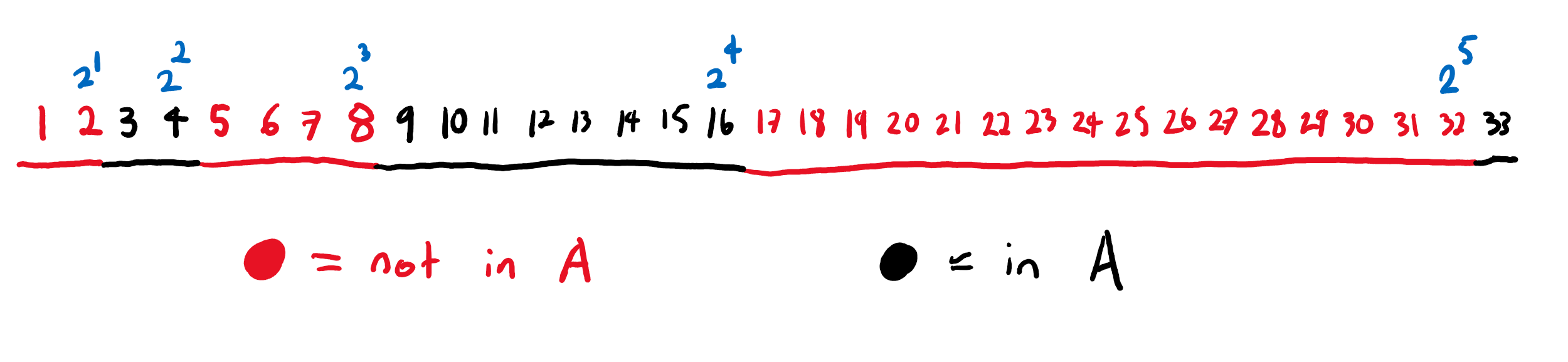
    Thus it would appear that we have an example of a finitely additive measure that is not countably additive. However there is a big problem with the above definition of \(\mathbb{P}\). Namely the limit of \(\frac{|\{k \in A \mid k \le n \}|}{n}\) does not always exist. Consider the set \(A = \{3,4,9,10,11,12,13,14,15,16,33,\ldots\}\), ie a number \(k \in \mathbb{N}\) is in \(A\) if and only if \(2^{m} < k \le 2^{m+1}\) for some odd number \(m\ge 1\). The idea with the set \(A\) is that it looks a little bit like this:

    There are chunks of numbers that alternate between being in \(A\) and not being in \(A\) and as we move further along, these chunks double in size. Let \(a_n\) represent the sequence of numbers \(\frac{|\{k \in A \mid k \le n \}|}{n}\). We can see that \(a_n\) increases while \(n\) is in a chunk that belongs to \(A\) and decreases when \(n\) is in a chunk not in \(A\). More specifically if \(2^{2m-1} < n \le 2^{2m}\), then \(a_n\) is increasing but if \(2^{2m} < n \le 2^{2m+1}\), then \(a_n\) is decreasing.

    At the turning points \(n = 2^{2m}\) or \(n = 2^{2m+1}\) we can calculate exactly what \(a_n\) is equal to. Note that

    \(\{k \in A \mid k \le 2^{2m} \} = 2+8+32+\ldots+2\cdot 4^{m-1} = 2\cdot \frac{4^m-1}{4-1} = \frac{2}{3}(4^m-1)\).

    Furthermore since there are no elements of \(A\) between \(2^{2m}\) and \(2^{2m+1}\) we have

    \(\{k \in A \mid k \le 2^{2m+1}\} = \frac{2}{3}(4^m-1)\).

    Thus we have

    \(a_{2^m} = \frac{\frac{2}{3}(4^m-1)}{2^{2m}}=\frac{2}{3}\frac{4^m-1}{4^m}\) and \(a_{2m+1} = \frac{\frac{2}{3}(4^m-1)}{2^{2m+1}}=\frac{1}{3}\frac{4^m-1}{4^m}.\)

    Hence the values \(a_n\) fluctuate between approaching \(\frac{1}{3}\) and \(\frac{2}{3}\). Thus the limit of \(a_n\) does not exist and hence \(\mathbb{P}\) is not well-defined.

    There is a work around using something called a Banach limit. Banach limits are a way of extending the notion of a limit from the space of convergent sequences to the space of bounded sequences. Banach limits aren’t uniquely defined and don’t have a formula describing them. Indeed to prove the existence of Banach limits one has to rely on non-constructive mathematics such as the Hanh-Banach extension theorem. So if we take for granted the existence of Banach limits we can define

    \(\mathbb{P}(A) = L\left( \left(\frac{|\{k \in A \mid k \le n \}|}{n}\right)_{n=1}^\infty \right)\),

    where \(L\) is now a Banach limit. This new definition of \(\mathbb{P}\) is defined on all subsets of \(\mathbb{N}\) and is an example of measure that is finitely additive but not countably additive. However the definition of \(\mathbb{P}\) is very non-constructive. Indeed there are models of ZF set theory where the Hanh-Banach theorem does not hold and we cannot prove the existence of Banach limits.

    This begs the question of whether or not there exist constructible examples of measures that are finitely additive but not countably additive. A bit of Googling reveals that non-principal ultrafilters provide another way of defining non-countably additive measures. However the existence of a non-principal ultrafilter on \(\mathbb{N}\) is again equivalent to a weak form of the axiom of choice. Thus it seems that the existence of a non-countably additive measure may be inherently non-constructive. This discussion on Math Overflow goes into more detail.

  • Why is the fundamental theorem of arithmetic a theorem?

    The fundamental theorem of arithmetic states that every natural number can be factorized uniquely as a product of prime numbers. The word “uniquely” here means unique up to rearranging. The theorem means that if you and I take the same number \(n\) and I write \(n = p_1p_2\ldots p_k\) and you write \(n = q_1q_2\ldots q_l\) where each \(p_i\) and \(q_i\) is a prime number, then in fact \(k=l\) and we wrote the same prime numbers (but maybe in a different order).

    Most people happily accept this theorem as self evident and believe it without proof. Indeed some people take it to be so self evident they feel it doesn’t really deserve the name “theorem” – hence the title of this blog post. In this post I want to highlight two situations where an analogous theorem fails.

    Situation One: The Even Numbers

    Imagine a world where everything comes in twos. In this world nobody knows of the number one or indeed any odd number. Their counting numbers are the even numbers \(\mathbb{E} = \{2,4,6,8,\ldots\}\). People in this world can add numbers and multiply numbers just like we can. They can even talk about divisibility, for example \(2\) divides \(8\) since \(8 = 4\cdot 2\). Note that things are already getting a bit strange in this world. Since there is no number one, numbers in this world do not divide themselves.

    Once people can talk about divisibility, they can talk about prime numbers. A number is prime in this world if it is not divisible by any other number. For example \(2\) is prime but as we saw \(8\) is not prime. Surprisingly the number \(6\) is also prime in this world. This is because there are no two even numbers that multiply together to make \(6\).

    If a number is not prime in this world, we can reduce it to a product of primes. This is because if \(n\) is not prime, then there are two number \(a \) and \(b\) such that \(n = ab\). Since \(a\) and \(b\) are both smaller than \(n\), we can apply the same argument and recursively write \(n\) as a product of primes.

    Now we can ask whether or not the fundamental theorem of arthimetic holds in this world. Namely we want to know if their is a unique way to factorize each number in this world. To get an idea we can start with some small even numbers.

    • \(2\) is prime.
    • \(4 = 2 \cdot 2\) can be factorized uniquely.
    • \(6\) is prime.
    • \(8 = 2\cdot 2 \cdot 2\) can be factorized uniquely.
    • \(10\) is prime.
    • \(12 = 2 \cdot 6\) can be factorized uniquely.
    • \(14\) is prime.
    • \(16 = 2\cdot 2 \cdot 2 \cdot 2\) can be factorized uniquely.
    • \(18\) is prime.
    • \(20 = 2 \cdot 10\) can be factorized uniquely.

    Thus it seems as though there might be some hope for this theorem. It at least holds for the first handful of numbers. Unfortunately we eventually get to \(36\) and we have:

    \(36 = 2 \cdot 18\) and \(36 = 6 \cdot 6\).

    Thus there are two distinct ways of writing \(36\) as a product of primes in this world and thus the fundamental theorem of arithmetic does not hold.

    Situtation Two: A Number Ring

    While the first example is fun and interesting, it is somewhat artificial. We are unlikely to encounter a situation where we only have the even numbers. It is however common and natural for mathematicians to be lead into certain worlds called number rings. We will see one example here and see what an effect the fundamental theorem of arithmetic can have.

    Consider wanting to solve the equation \(x^2+19=y^3\) where \(x\) and \(y\) are both integers. One way to try to solve this is by rewriting the equation as \((x+\sqrt{-19})(x-\sqrt{-19}) = y^3\). With this rewriting we have left the familiar world of the whole numbers and entered the number ring \(\mathbb{Z}[\sqrt{-19}]\).

    In \(\mathbb{Z}[\sqrt{-19}]\) all numbers have the form \(a + b \sqrt{-19}\), where \(a\) and \(b\) are integers. Addition of two such numbers is defined like so

    \((a+b\sqrt{-19}) + (c + d \sqrt{-19}) = (a+c) + (b+d)\sqrt{-19}\).

    Multiplication is define by using the distributive law and the fact that \(\sqrt{-19}^2 = -19\). Thus

    \((a+b\sqrt{-19})(c+d\sqrt{-19}) = (ac-19bd) + (ad+bc)\sqrt{-19}\).

    Since we have multiplication we can talk about when a number in \(\mathbb{Z}[\sqrt{-19}]\) divides another and hence define primes in \(\mathbb{Z}[\sqrt{-19}]\). One can show that if \(x^2 + 19 = y^3\), then \(x+\sqrt{-19}\) and \(x-\sqrt{-19}\) are coprime in \(\mathbb{Z}[\sqrt{-19}]\) (see the references at the end of this post).

    This means that there are no primes in \(\mathbb{Z}[\sqrt{-19}]\) that divides both \(x+\sqrt{-19}\) and \(x-\sqrt{-19}\). If we assume that the fundamental theorem of arthimetic holds in \(\mathbb{Z}[\sqrt{-19}]\), then this implies that \(x+\sqrt{-19}\) must itself be a cube. This is because \((x+\sqrt{-19})(x-\sqrt{-19})=y^3\) is a cube and if two coprime numbers multiply to be a cube, then both of those coprime numbers must be cubes.

    Thus we can conclude that there are integers \(a\) and \(b\) such that \(x+\sqrt{-19} = (a+b\sqrt{-19})^3 \). If we expand out this cube we can conclude that

    \(x+\sqrt{-19} = (a^3-57ab^2)+(3a^2b-19b^3)\sqrt{-19}\).

    Thus in particular we have \(1=3a^2b-19b^3=(3a^2-19b^2)b\). This implies that \(b = \pm 1\) and \(3a^2-19b^2=\pm 1\). Hence \(b^2=1\) and \(3a^2-19 = \pm 1\). Now if \(3a^2 -19 =-1\), then \(a^2=6\) – a contradiction. Similarly if \(3a^2-19=1\), then \(3a^2=20\) – another contradiction. Thus we can conclude there are no integer solutions to the equation \(x^2+19=y^3\)!

    Unfortunately however, a bit of searching reveals that \(18^2+19=343=7^3\). Thus simply assuming that that the ring \(\mathbb{Z}[\sqrt{-19}]\) has unique factorization led us to incorrectly conclude that an equation had no solutions. The question of unique factorization in number rings such as \(\mathbb{Z}[\sqrt{-19}]\) is a subtle and important one. Some of the flawed proofs of Fermat’s Last Theorem incorrectly assume that certain number rings have unique factorization – like we did above.

    References

    The lecturer David Smyth showed us that the even integers do not have unique factorization during a lecture of the great course MATH2222.

    The example of \(\mathbb{Z}[\sqrt{-19}]\) failing to have unique factorization and the consequences of this was shown in a lecture for a course on algebraic number theory by James Borger. In this class we followed the (freely available) textbook “Number Rings” by P. Stevenhagen. Problem 1.4 on page 8 is the example I used in this post. By viewing the textbook you can see a complete solution to the problem.