Category: Fun

  • An art and maths collaboration

    Over the course of the past year I have had the pleasure to work with the artist Sanne Carroll on her honours project at the Australian National University. I was one of two mathematics students that collaborated with Sanne. Over the course of the project Sanne drew patterns and would ask Ciaran and I to recreate them using some mathematical or algorithmic ideas. You can see the final version of project here: https://www.sannecarroll.com/ (best viewed on a computer).

    I always loved the patterns Sanne drew and the final project is so well put together. Sanne does a great job of incorporating her drawings, the mathematical descriptions and the communication between her, Ciaran and me. Her website building skills also far surpass anything I’ve done on this blog!

    It was also a lot of fun to work with Sanne. Hearing about her patterns and talking about maths with her was always fun. I also learnt a few things about GeoGebra which made the animations in my previous post a lot quicker to make. Sanne has told me that she’ll be starting a PhD soon and I’m looking forward to any future collaborations that might arise.

  • Cayley Graphs and Cakes

    Over the past month I have been studying at the AMSI Summer School at La Trobe University in Melbourne. Eight courses are offered at the AMSI Summer School and I took the one on geometric group theory. Geometric group theory is also the subject of my honours thesis and a great area of mathematics. I previously wrote about some ideas from geometric group theory here.

    One of the main ideas in geometric group theory is to take a finitely generated group and turn it into a geometric object by constructing a Cayley graph (or in Germany, a Dehn gruppenbild or Dehn group picture).

    If \(G\) is a group with a generating set \(A\), then the Cayley graph of \((G,A)\) has the elements of the group as vertices and for each group element \(g \in G\) and generator \(a \in A\), there is an edge from \(g\) to \(ga\).

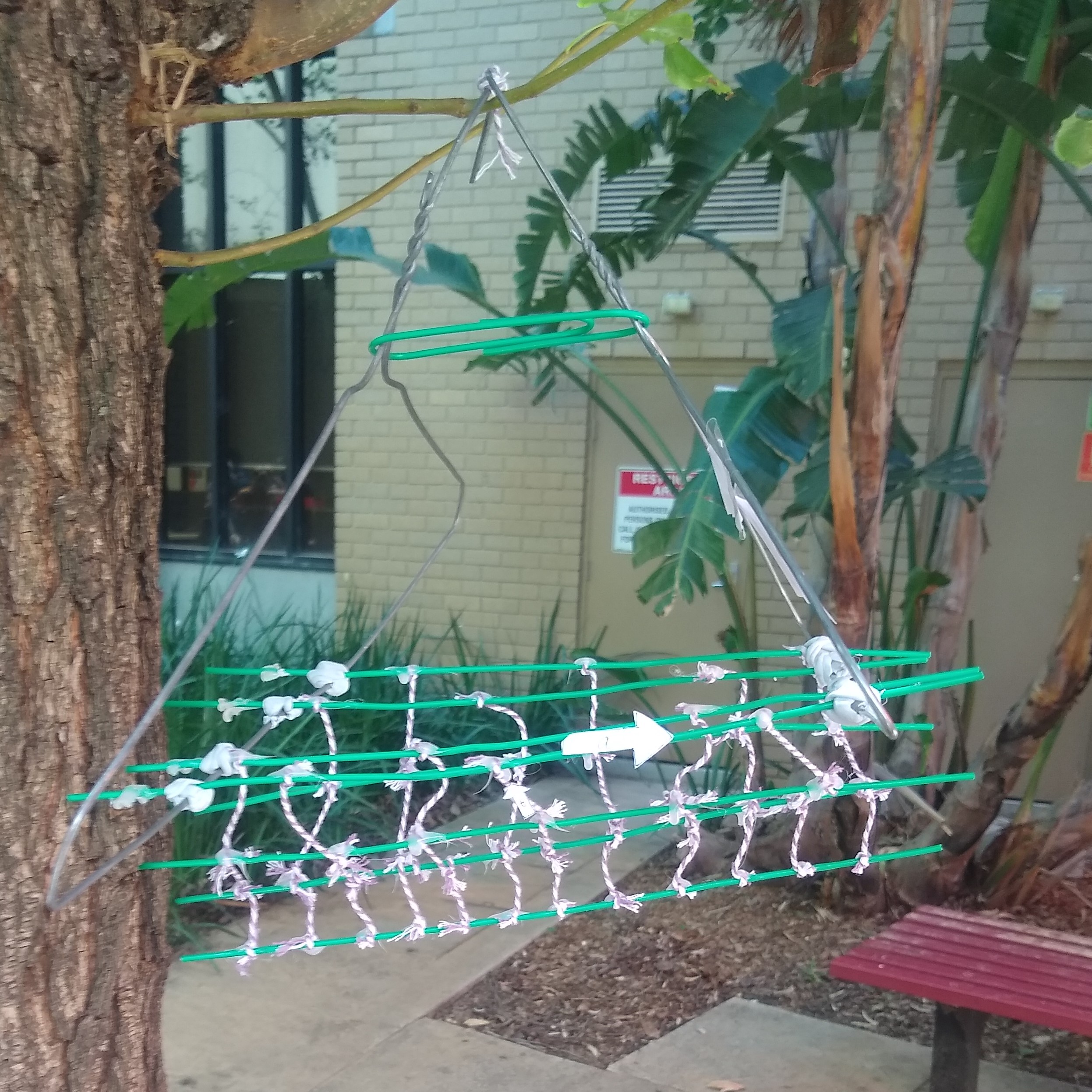
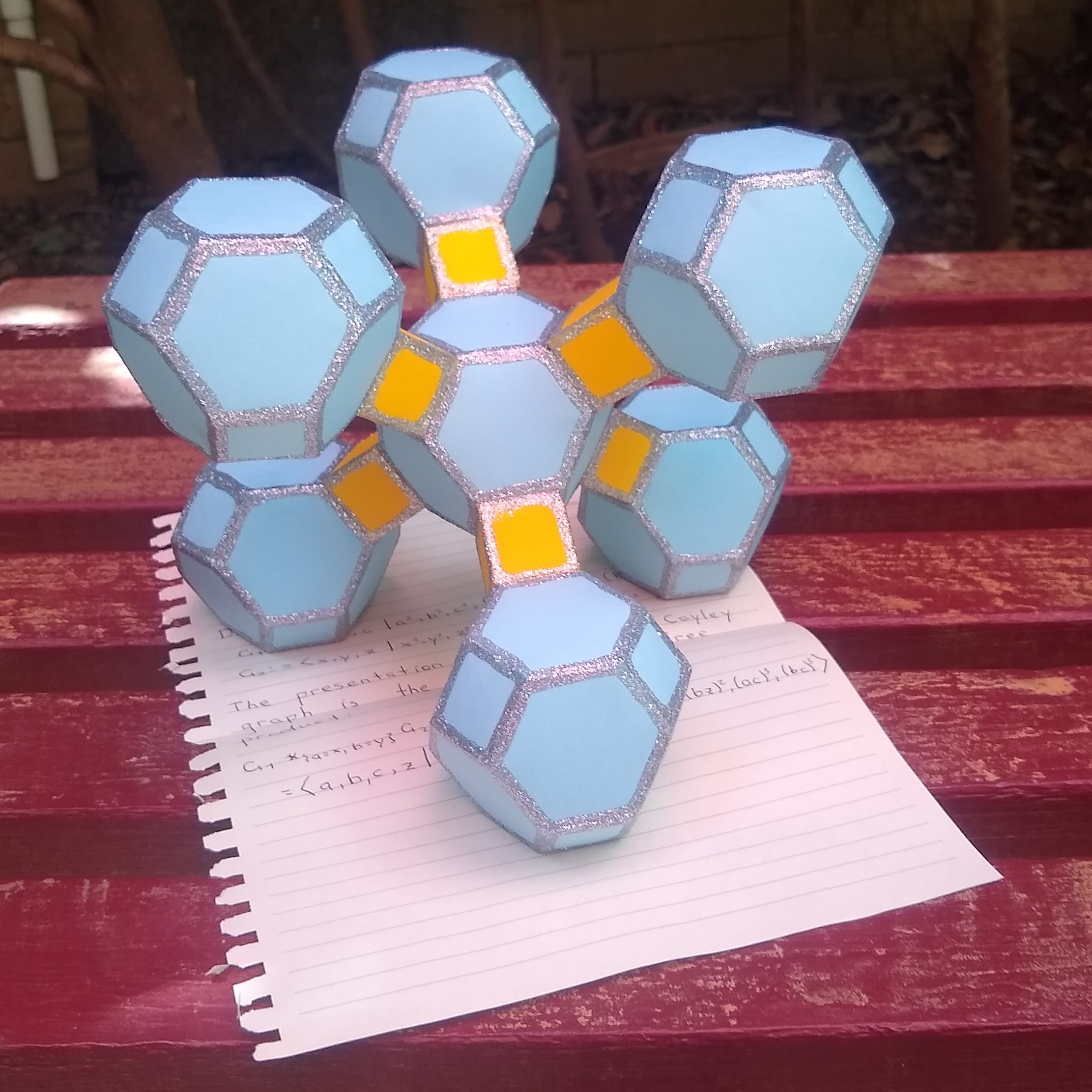
    Cayley graphs can be very pretty and geometrical interesting. In the final week of the course, our homework was to creatively make a Cayley graph. Here’s a sample of the Cayley graphs we made.

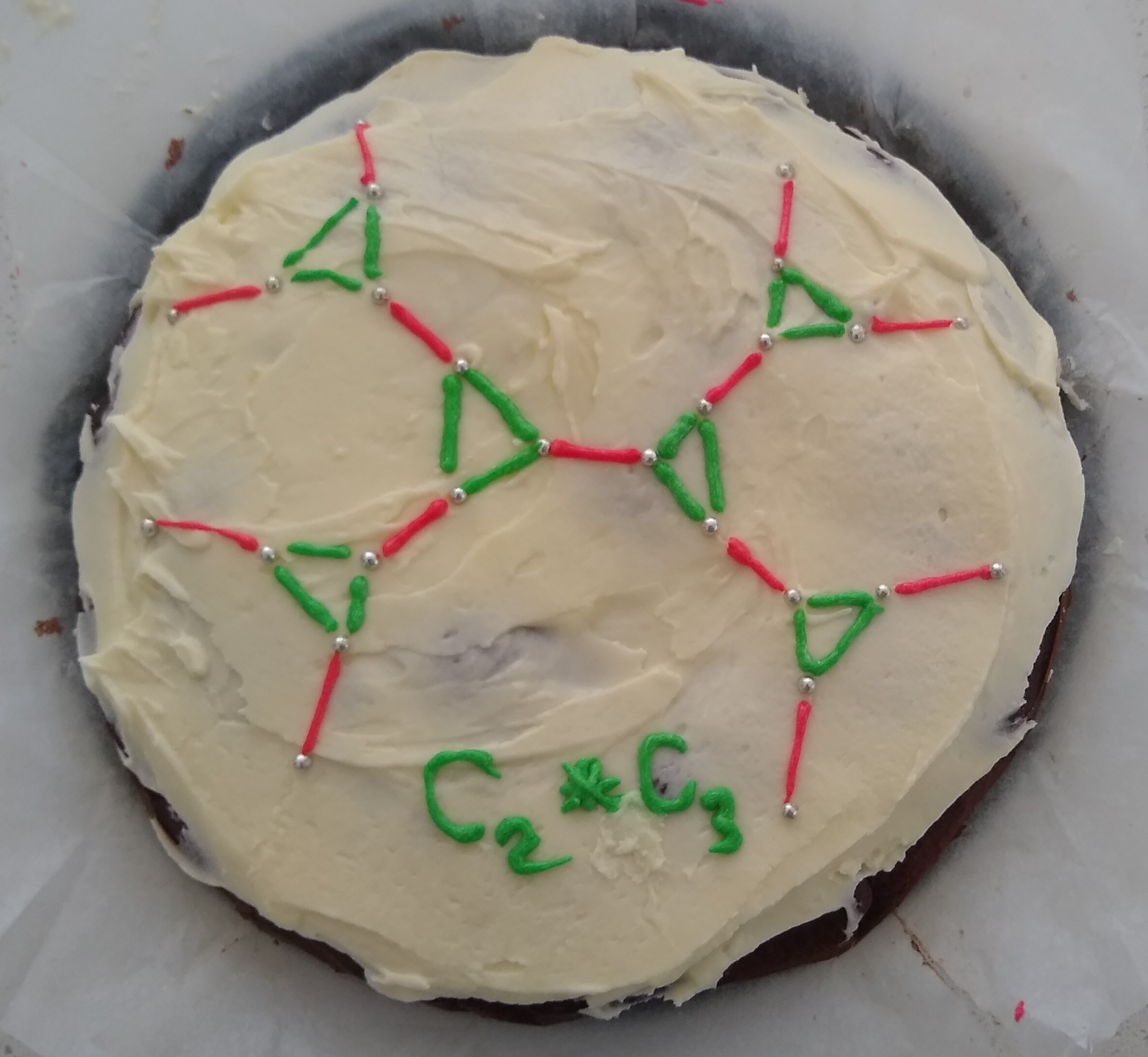
    With a friend I baked a cake and decorated it with the Cayley graph of the group \(C_2 * C_3 \cong \langle a ,b \mid a^2,b^3 \rangle\) with respect to the generating set \(\{a,b\}\). We were really happy with how it looked and tasted and are proud to say that the whole thing got eaten at a BBQ for the summer school students.

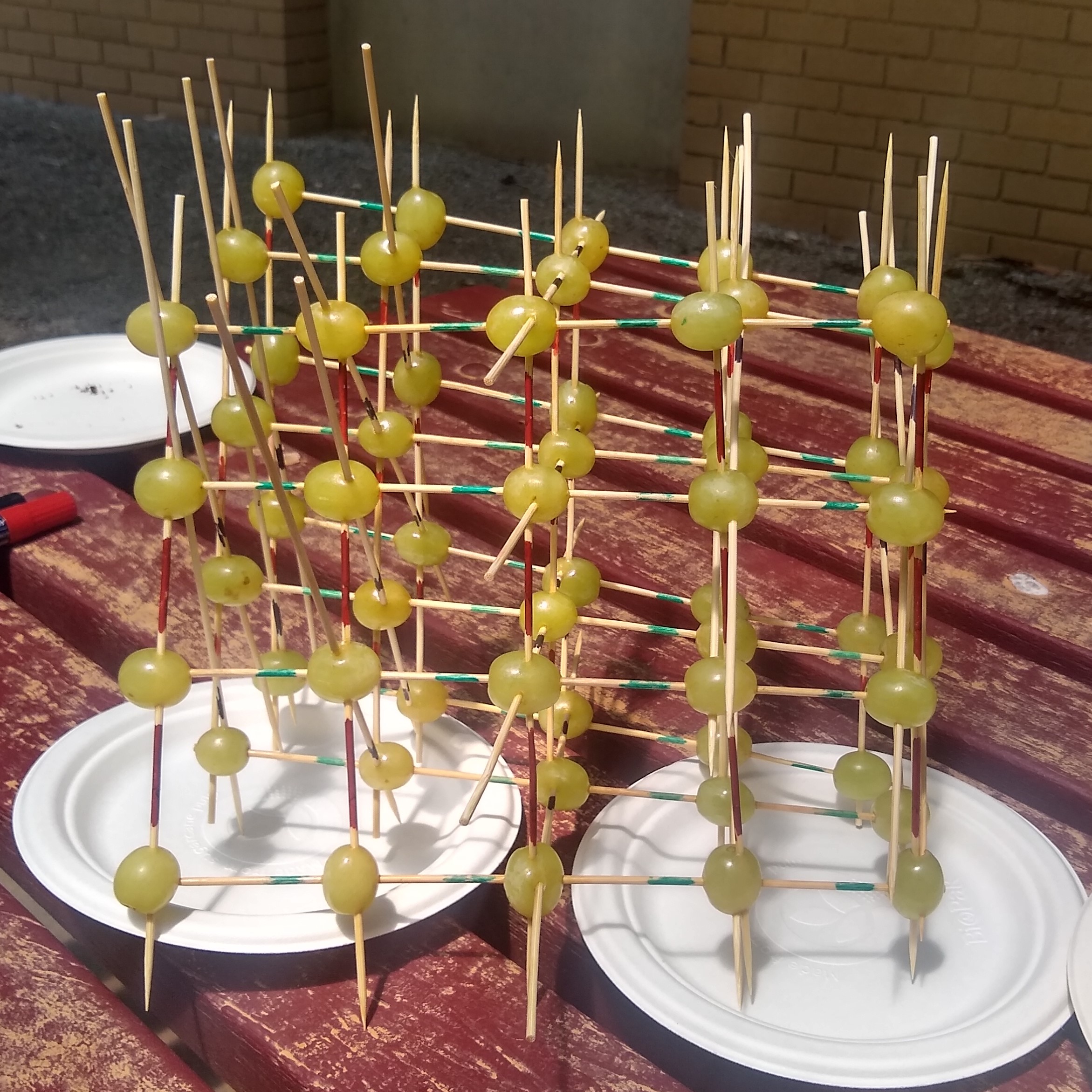
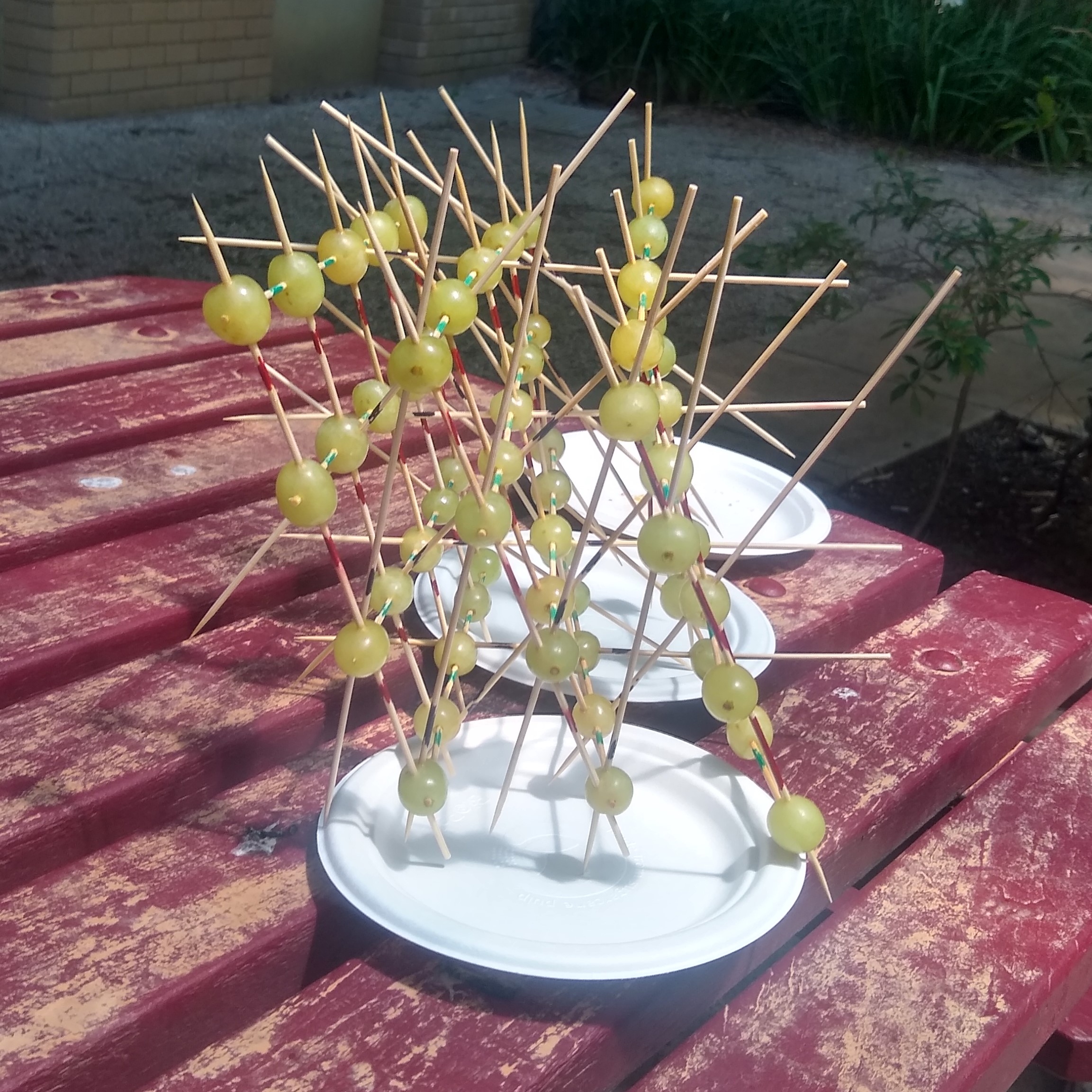
    Staying with the food theme, a friend use grapes and skewers to make their Cayley graph. It’s a graph of the discrete Heisenberg group \(\langle a,b,c \mid ac=ca, bc=cb, ba=abc \rangle\). I was amazed at the structural integrity of the grapes. There’s a video about this Cayley graph that you can watch here (alternatively it’s the first result if you seach “Heisenberg group grapes”).

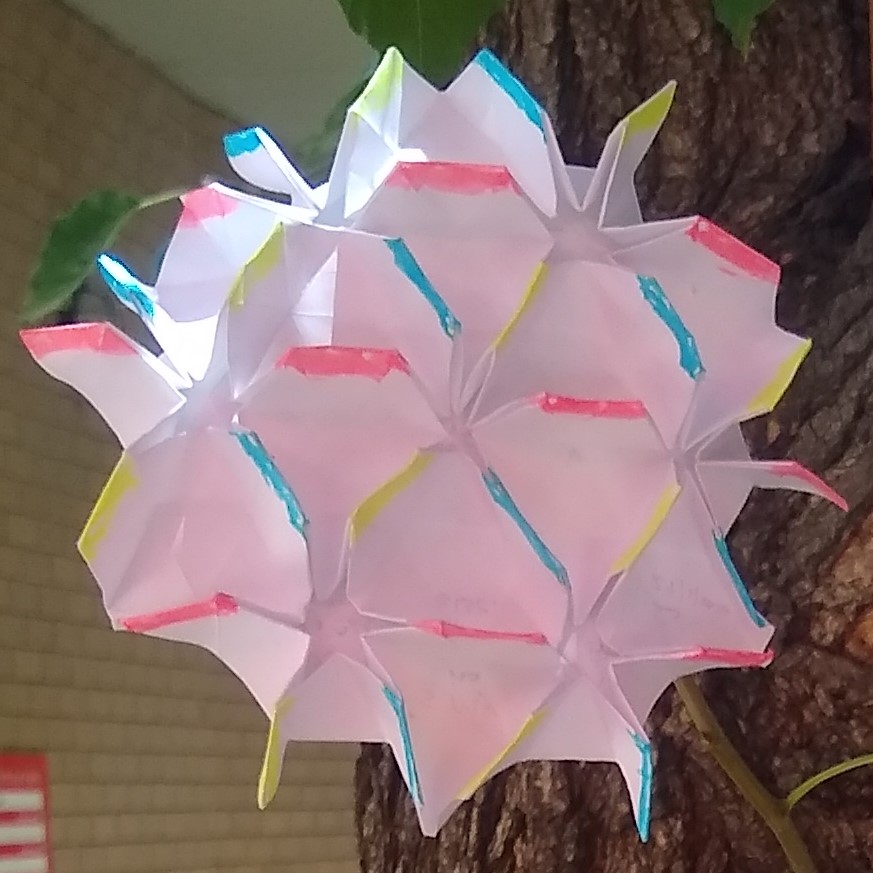
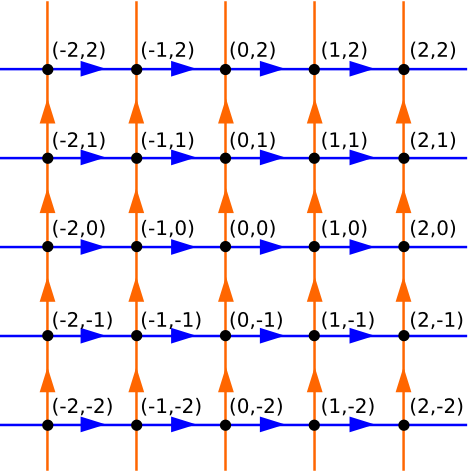
    This Cayley graph is made out of paper and shows how picking a different generating set \(A\) can change the appearance of the Cayley graph. It is a Cayley graph of \(\mathbb{Z}^2\). Normally this Cayley graph is drawn with respect to the generating set \(\{(1,0),(0,1)\}\) and Cayley graph looks like the square lattice on the right. The Cayley graph on the left was made with respect to the generating set \(\{(1,0),(0,1),(1,1)\}\) and the result is a triangular tiling of the plane. Note that while the two Cayley graphs of \(\mathbb{Z}^2\) look quite different, they have some important shared properties. In particular, both of them are two dimensional and flat. (The second image is taken from here)

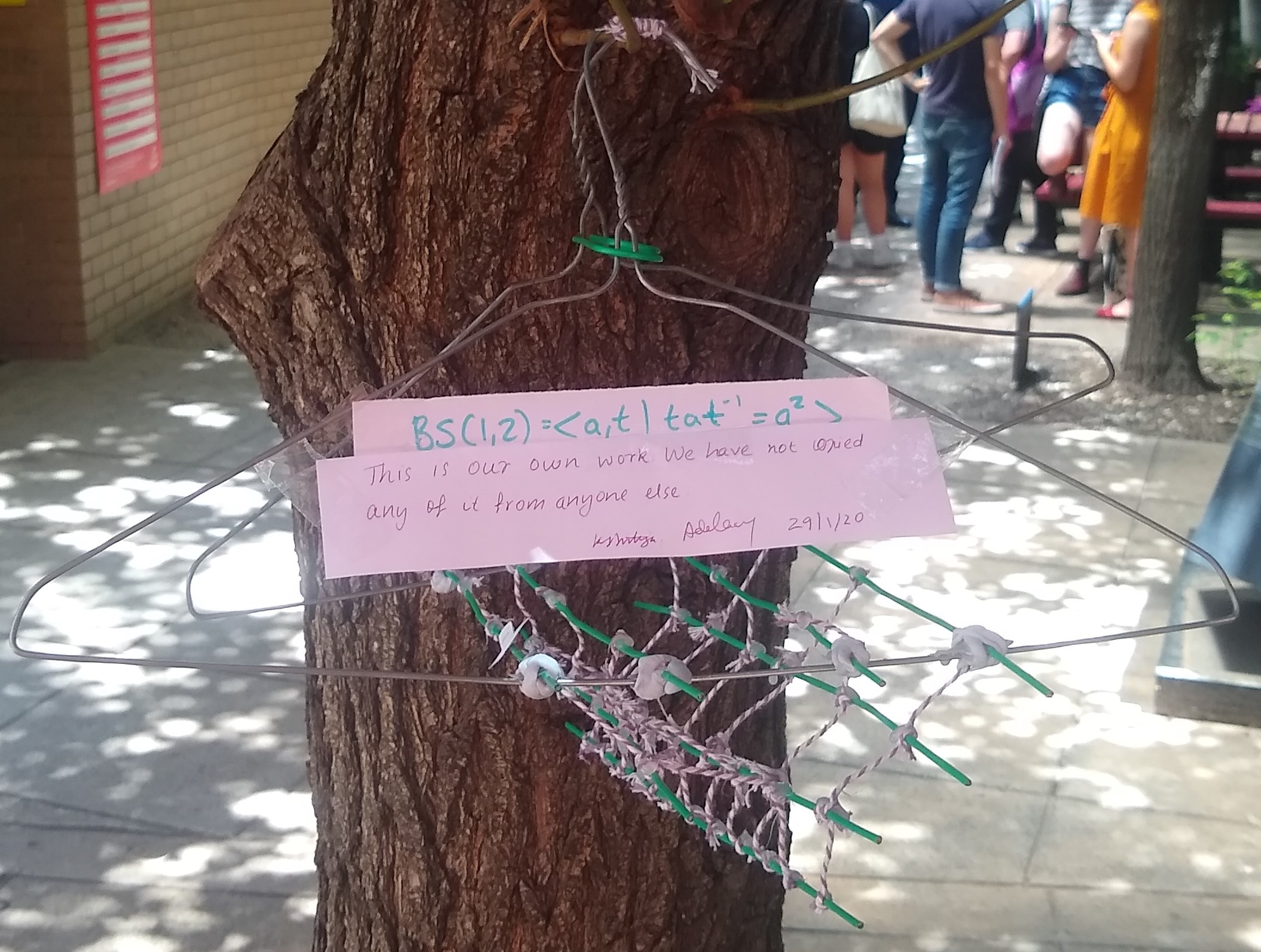
    Someone also made a Cayley graph of the Baumslag Solitar group \(\text{BS}(1,2) \cong \langle a,t \mid tat^{-1}=a^2 \rangle\) with respect to \(\{a,t\}\). This was a group that came up frequently in the course as it can be used to construct a number of surprising counter examples.

    Finally, my favourite Cayley graph of the day was the incredibly pretty Cayley graph of the Coxeter group

    \(\langle a,b,c,d \mid a^2, b^2, c^2, d^2, (ab)^3, (bc)^3, (ac)^2, (ad)^2, (cd)^2 \rangle\)

    with respect to the set \(\{a,b,c,d\}\).

    I’d like to thank both AMSI and La Trobe for putting on the Summer School and the three geometric group theory lecturers Alejandra Garrido, Murray Elder and Lawrence Reeves for teaching a great course. A huge thanks to the other students for making some great Cayley graphs and letting me share some of them.

  • Facebook and Graph Theory

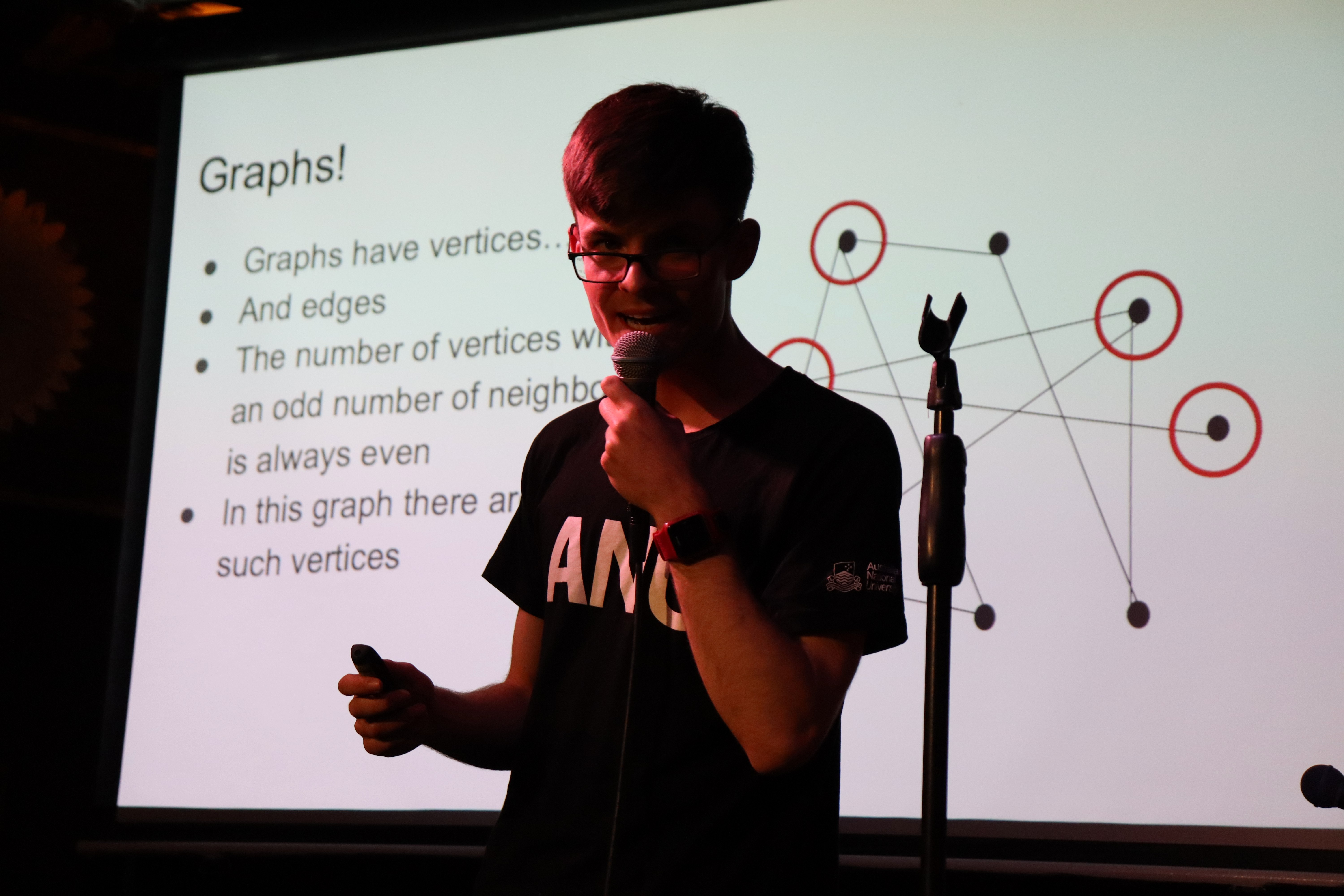
    Earlier this week I spoke at Maths and Computer Science in the Pub. The event was hosted by Phil Dooley and sponsored by the Mathematical Sciences Institute. I had a great time talking and hearing from the other presenters. Below is a photo of me presenting and a transcript of my talk.

    Right now the number of people with an odd number of Facebook friends is an even number. In fact at any point in time the number of people with an odd number of Facebook friends is an even number. Why is this true? We could check this claim by counting exactly how many people have an odd number of friends but this is much too complicated. An easy answer can be founded by using a common mathematical approach called counting in different ways.

    For each Facebook user, imagine looking at how many Facebook friends they have and add up all those numbers. We can write this quantity as an intimidating sum:

    \(\sum\limits_{\text{Facebook users}} \text{number of friends}.\)

    Another way of counting the same thing is to look at the number of friendships and multiply that number by 2. This is because each friendship is between two people. When we counted the first number we double counted every friendship. We can write this in an equation:

    \(\sum\limits_{\text{Facebook users}} \text{number of friends} = 2\cdot(\text{number of friendships}).\)

    The important thing that this tells us is that the sum on the left is an even number. We can split this sum into two sums. We could first add up how many Facebook friends all of the people who have an even number of friends. Then we can add up how many Facebook friends all of the people with an odd number of friends have. These two sums added together gives us the original sum which is an even number.

    \(\sum\limits_{\text{even Facebook users}} \text{number of friends}+\sum\limits_{\text{odd Facebook users}} \text{number of friends} = 2\cdot(\text{number of friendships}).\)

    In the first sum, all of the people have an even number of Facebook friends so all of the numbers are even. Thus the first sum is an even number. If we subtract this first sum from both sides, then we can see that the second sum is equal to an even number minus an even number. Hence the second sum in an even number.

    \(\sum\limits_{\text{odd Facebook users}} \text{number of friends} = 2\cdot(\text{number of friendships})-\sum\limits_{\text{even Facebook users}} \text{number of friends}.\)

    In the second sum, all of the people have an odd number of friends. Thus all of the numbers must be odd. So we are adding up a bunch of odd numbers and getting an even number. The only way this is possible is if we have an even number of terms. That is if we have an even number of people with an odd number of Facebook friends.

    So there you have it, the number of people with an odd number of Facebook friends is an even number. You can be sure of this fact thanks to a mathematical proof but why should we stop there? One thing mathematicians love to do is generalise their results. The only things we needed to know about Facebook was that there are a bunch of people with Facebook accounts and there are some pairs of people whose Facebook accounts are linked by being friends. If we take this abstract view of Facebook we arrive at the definition of a graph. A graph consists of a set of points called vertices and a set of connections between some pairs of vertices called edges.

    Facebook is an example of a graph but there are many other examples. For each graph we get a fact analogous to the number of people with an odd number of Facebook friends being even. We learn that the number of vertices with an odd number of neighbours is an even number. The exact same proof works if at every point we replace “person” with “vertex”, “Facebook friend” with “neighbour” and “friendship” with “edge”.

    For example if there’s a big party, we can make a graph where the vertices are people who attended the party and there is an edge between two people if they hugged at the party. Then the theorem tells us that the number of people who hugged an odd number of people is an even number.

    Unfortunately not everything is a graph. In particular Instagram and Twitter are not graphs. On these social media platforms, you can follow someone without them following you back. This breaks the proof I gave before and it’s not always true that the number of people with an odd number of Instagram followers is always even. In fact it fluctuates between even and odd whenever someone follows or unfollows someone else.

    So if someone asks you what the difference between Facebook and Instagram is, now you know. On Facebook the number of people with an odd number of Facebook friends is always even.